Why Your Audience Is Your Most Valuable Startup Asset
November 2025 · 7 min read

Peter Thiel wrote in Zero to One that most startups fail not because their product is bad, but because they cannot get it in front of enough people. Distribution, not product, is the number one killer of startups. If you are a creator with an engaged audience, you have already solved the hardest problem in business. And most creators do not realize how valuable that is.
The Customer Acquisition Crisis in Startups
The average B2B SaaS company spends $702 per customer acquired, according to 2025 benchmarks from First Page Sage. For enterprise deals, that number climbs to $1,200. In fintech, it reaches $1,450. These are not small numbers, and they are getting worse: customer acquisition costs rose 14% through 2025 while overall SaaS growth slowed.
Here is what that looks like in practice. A typical early-stage SaaS startup raises $2 million in seed funding. If customer acquisition eats 40% of that (a common ratio), they have $800,000 to spend on getting customers. At $700 per customer, that buys them roughly 1,140 customers. If the product charges $29 per month, those customers generate about $33,000 in monthly recurring revenue. It took $800,000 and months of marketing effort to get there.
The CAC payback period for private SaaS companies now averages 23 months, meaning it takes nearly two years to recover the cost of acquiring a single customer. Many startups never reach profitability because they run out of funding before they recoup their acquisition costs. Great products die every day because their creators could not solve distribution.
Distribution Is Everything
Thiel was not alone in this observation. Reid Hoffman, co-founder of LinkedIn, has said that the most underestimated advantage in startups is distribution. The companies that win are rarely the ones with the best technology. They are the ones that get their product in front of the right people at the right time.
The traditional startup playbook runs like this: build a product, raise money, spend that money on ads and sales teams, hope enough people convert, raise more money, repeat. It is expensive, uncertain, and structurally inefficient. The vast majority of venture-backed startups fail, and distribution is the primary reason.
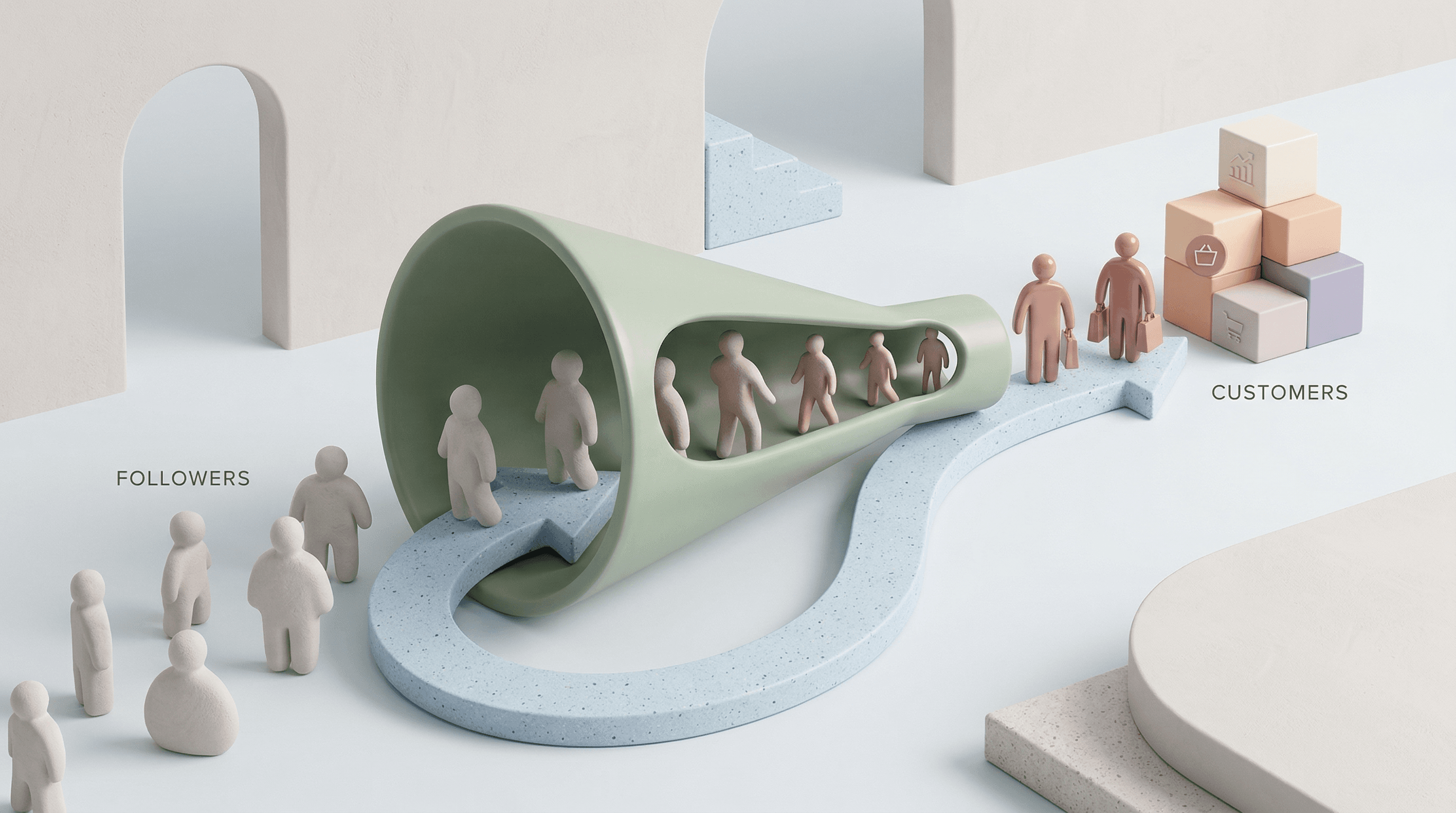
The creator playbook inverts this sequence entirely. You already have the audience. You already have the trust. You already have a direct channel to people who care about what you say and do. The question is not "how do I find customers?" but rather "what should I build for the customers I already have?"
This inversion is a massive structural advantage. It means a creator launching a software product can skip the most expensive, most failure-prone phase of startup building. No cold outreach. No paid acquisition campaigns. No praying that the Facebook algorithm shows your ad to the right people. You just tell your audience about your product, and the ones who need it will sign up. As we explored in why creators are building software companies, this distribution advantage is the primary reason software makes so much sense for creators specifically.
Product-Market Fit Is Easier When You Know Your Market
Traditional startups spend thousands on user research, customer interviews, surveys, and focus groups trying to understand what their target market actually wants. They hire consultants. They build MVPs. They iterate through months of feedback cycles. And even then, product-market fit is not guaranteed. Most startups pivot at least once before finding something that works.
Creators have an unfair advantage here too. You talk to your audience every single day through comments, DMs, live streams, and social posts. You see what questions get asked repeatedly. You know which problems come up over and over. You have thousands of data points about what your audience struggles with, wishes existed, and would be willing to pay for.
Product-market fit, for a creator, is not a guess. It is a conversation you have been having for years. That fitness YouTuber who gets asked "what app do you use to track macros?" in every comment section already knows the product to build. That business creator whose audience constantly asks about invoicing and client management already has the product spec written in their DMs.
This direct feedback loop is something money cannot buy. Startups pay for it. Creators already have it. The only question is whether you are paying attention to the signals your audience is already sending you. For a detailed playbook on this process, check out our article on converting followers to customers.
The Numbers That Matter
Let us make this concrete. Say you have 100,000 followers across your platforms. That is not a massive audience by creator standards, but it is more than enough.
If 1% convert to paying customers for a $29/month software tool, that is 1,000 customers. 1,000 customers at $29 per month equals $29,000 in monthly recurring revenue. That is $348,000 per year.
A traditional SaaS startup typically spends 12 to 18 months getting to their first 1,000 customers. They burn through hundreds of thousands of dollars in marketing spend to get there. A creator with an engaged audience can reach this milestone with a single product launch. Not in 18 months. In weeks.
And that is just the starting point. With a 5% monthly growth rate (achievable through a combination of audience growth and product improvement), that $29,000 MRR becomes $47,000 in 12 months and $77,000 in 24 months. The compounding effect of subscription revenue, combined with continuous audience growth, creates a flywheel that accelerates over time.
This is exactly the kind of opportunity that BuildVentureLab helps creators execute. The model is straightforward: the creator provides the audience and vision, while an experienced product team handles the design, engineering, and scaling. The creator holds meaningful equity in a business built on their most valuable asset: their audience.
Your Audience Tells You What to Build
The best creator-led products are not invented out of thin air. They emerge from patterns in audience engagement. The questions your followers ask repeatedly are product features waiting to be built. The frustrations they share are problems waiting to be solved. The tools they ask you to recommend are market gaps waiting to be filled.
Pay attention to your comments, DMs, and live stream interactions. Track the questions that come up most frequently. Notice when multiple people describe the same pain point. That convergence is where your product opportunity lives.
Creators who have built successful software products almost universally describe the same experience: "I kept hearing the same question from my audience, so I built the answer." The ones who listen are the ones who build products people actually want. And a product people actually want, distributed to an audience that already trusts you, is as close to a guaranteed outcome as business gets.
For a broader look at the business model behind this, our guide to SaaS for creators breaks down the economics in detail.
Your audience is not just people who watch your content. They are a distribution channel, a focus group, a customer base, and a community, all at once. The creators who recognize this will build companies. The rest will keep chasing views, hoping the next video goes viral, wondering why the numbers never quite add up. The asset has been sitting in front of you the whole time. The only question is what you are going to build with it.
Built by the team behind a $1B+ SaaS portfolio
Over the past decade, our 90+ person team has launched and scaled SaaS products across every vertical, generating over $1B in company-wide revenue. Now we partner with creators and manage every aspect of the product, from build through ongoing growth. You bring the distribution. We bring everything else.
Apply for a Partnership