Creator Economy 2026: Five Trends Every Influencer Should Know
January 2026 · 10 min read

The creator economy hit $250 billion in 2024 and shows no signs of slowing down. Goldman Sachs Research projects it will reach $480 billion by 2027, nearly doubling in three years. But the way creators earn money inside that economy is changing fast, and the ones who see these shifts early will be the ones who benefit most. Here are five trends reshaping the creator economy in 2026 that every influencer, YouTuber, and content creator should understand.
Community-Led Businesses
The first major shift is the move from broadcasting to community building. For years, creators focused on growing follower counts and maximizing reach. In 2026, the smartest creators are realizing that a smaller, deeply engaged community is worth more than a massive passive audience.
This is not just a philosophical shift. It is an economic one. Creators launching paid communities on platforms like Circle, Skool, and Discord are generating recurring revenue from members who pay $20 to $100+ per month for access to exclusive content, direct interaction, and peer networking. A creator with 500 paying community members at $50 per month generates $25,000 in monthly revenue from a group small enough to know by name.
Brand partnerships still account for roughly 70% of total creator income in 2025, but that percentage is declining as more creators build owned revenue streams. Community is the bridge between content and commerce. When you know your audience personally, you know what they need, what they will pay for, and how to serve them better than any brand deal ever could.
The creators who build real communities are also the ones with the highest lifetime value per follower. A subscriber who joins your community, buys your product, and stays for two years is worth exponentially more than someone who watched one video and never came back. The math favors depth over breadth.
Owned Revenue Over Platform-Dependent Revenue
The second trend is a deliberate move away from platform-dependent income. YouTube's Partner Program, TikTok's creator fund, Instagram's bonuses: these are all controlled by platforms that can change the rules at any time. And they regularly do.
TikTok creators experience the most extreme version of this volatility, with monthly earnings fluctuating an average of 58%. Even YouTube, the most stable platform for ad revenue, saw CPMs shift dramatically with algorithm updates in 2025. When your income depends entirely on a platform's decisions, you do not have a business. You have a job where your employer can change your salary without notice.
The response is a flight to owned properties. Email lists, personal websites, own products, and direct customer relationships. Kevin Kelly's "1,000 True Fans" theory, which argued that a creator only needs 1,000 fans willing to pay $100 per year to earn a living, is finally being realized at scale. Except in 2026, the numbers are bigger: creators are building products where 1,000 true fans pay $19 to $49 per month, generating six-figure monthly recurring revenue.
The shift is about control. When you own the product, you own the revenue. When you own the customer relationship, no algorithm change can take it away. As we explored in our article on why creators are building software companies, this move toward ownership is the defining theme of the next era of the creator economy.
Creator-Led SaaS
The third trend is the most exciting for creators who think like entrepreneurs: creators are not just promoting software anymore. They are owning it.
For years, the creator-software relationship was simple. A SaaS company paid a creator to promote their tool. The creator got a flat fee or an affiliate commission. The software company got customers. But increasingly, creators are asking a better question: "Why am I sending my audience to someone else's product when I could build my own?"
The partnership model is what makes this possible. Creators do not need to learn to code. They need a technical partner who can build and maintain the product while the creator provides the audience, domain expertise, and ongoing engagement. Companies like BuildVentureLab specialize in exactly this: partnering with creators to design, build, and scale SaaS products where the creator holds equity and participates in the long-term upside.
Venture capital is taking notice. Creator economy startups attracted $1.5 billion in funding in 2024, and the first half of 2025 saw over $1.6 billion, putting the sector on pace to exceed $2 billion for the full year. M&A deal volume increased 17.4% year over year. The money is flowing because the economics work: a creator with built-in distribution and a software product with 80%+ margins is a compelling investment thesis.
AI as an Accelerator, Not a Replacement
The fourth trend addresses the elephant in every room: 84% of creators already use AI-powered tools in their workflows, according to industry surveys. AI is making content production faster, cheaper, and more accessible. But this is creating a paradox that works in favor of human creators.
As AI-generated content floods every platform, the supply of generic content is approaching infinity. When supply is infinite, the value of any individual piece drops toward zero. But human creators offer something AI cannot replicate: trust, personality, lived experience, and genuine connection with an audience. Those qualities become more valuable as AI content becomes more common, not less.
The smart play is not to resist AI but to use it as infrastructure. Use AI to handle editing, repurposing, analytics, and repetitive tasks. Use AI to lower the cost of building software products (AI is cutting development timelines significantly). But keep the human element front and center: your face, your voice, your perspective, your relationship with your audience.
AI also lowers the barrier to building software. Tools that once required large engineering teams can now be prototyped and iterated on faster than ever. For creators interested in launching software products, the cost and timeline have never been more accessible.
Institutional Capital Entering the Creator Economy
The fifth trend is perhaps the strongest signal that the creator economy has matured: serious institutional money is entering the space. This is not just angel investors writing small checks. Venture capital firms, private equity groups, and even traditional media companies are investing directly in creator-led businesses.
MrBeast's Beast Industries raised a $300 million Series C at a $5 billion valuation from Alpha Wave. Dude Perfect sold shares to Highmount Capital, raising $100 million. Whatnot doubled its valuation to $11.5 billion. Slow Ventures launched a dedicated $60 million creator fund. These are not small bets.
For individual creators, this means more resources, more partners, and more infrastructure available to help build real businesses. The creator economy is professionalizing. The founders who happen to be creators are getting the same quality of backing that traditional tech founders have enjoyed for decades.
This professionalization also means higher expectations. Investors want to see real business models, not just follower counts. Creators who can demonstrate recurring revenue, strong unit economics, and a path to profitability are the ones attracting capital. The era of "big following equals big valuation" is over. The era of "big following plus real business equals big valuation" is just beginning.
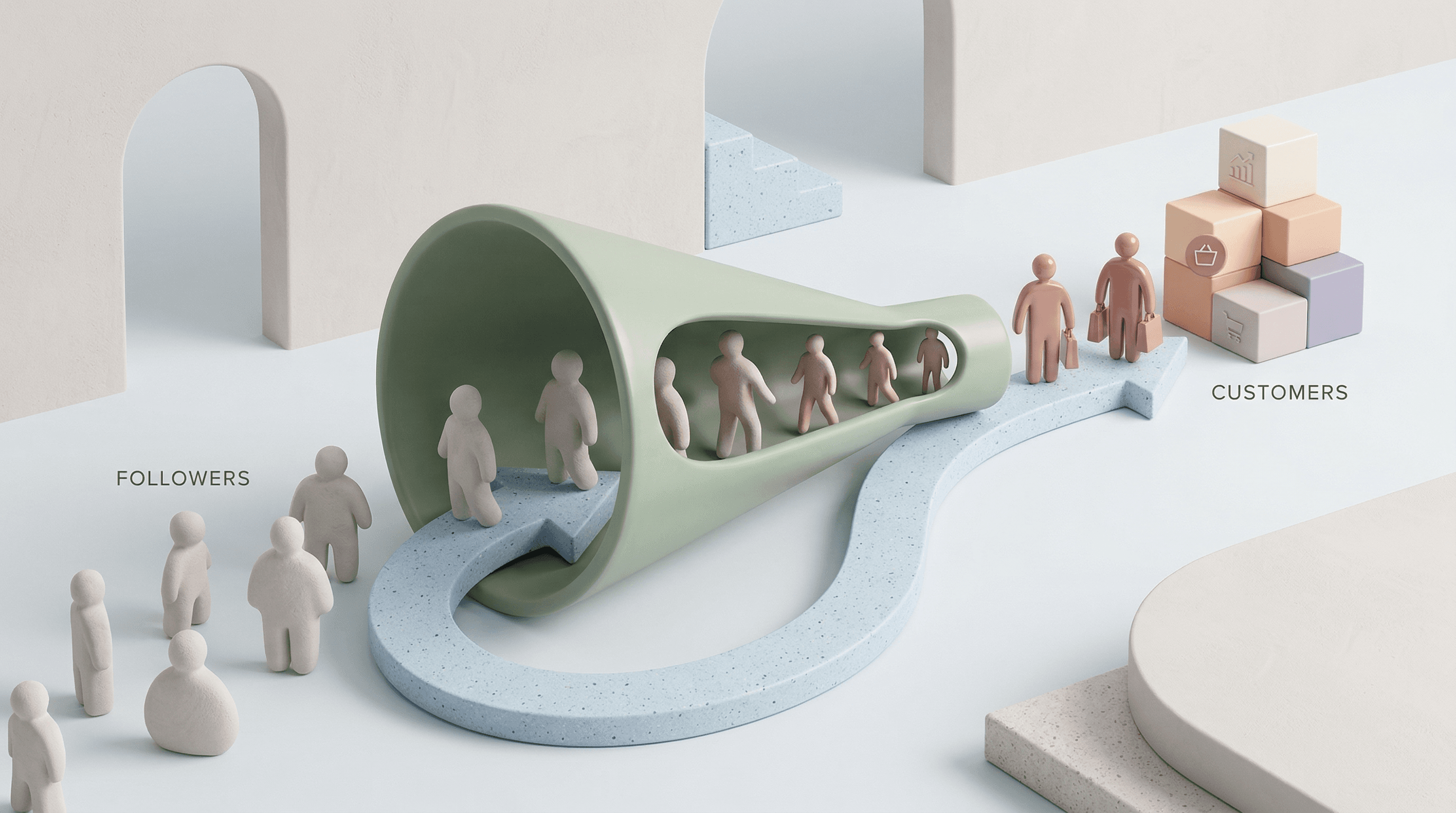
For a closer look at how to turn followers into actual customers, read our article on the conversion playbook. And if you are curious about why your audience might be your most valuable business asset, we wrote about that too in our piece on audience as a startup asset.
Each of these five trends points in the same direction: creators are becoming business owners. The ones who treat 2026 as the year they stop being content producers and start being entrepreneurs will look back on this moment as the turning point. The creator economy is not just growing. It is evolving. And the creators who evolve with it will build something that lasts far longer than any viral video.
Built by the team behind a $1B+ SaaS portfolio
Over the past decade, our 90+ person team has launched and scaled SaaS products across every vertical, generating over $1B in company-wide revenue. Now we partner with creators and manage every aspect of the product, from build through ongoing growth. You bring the distribution. We bring everything else.
Apply for a Partnership