From Followers to Customers: The Creator Conversion Playbook
July 2025 · 8 min read
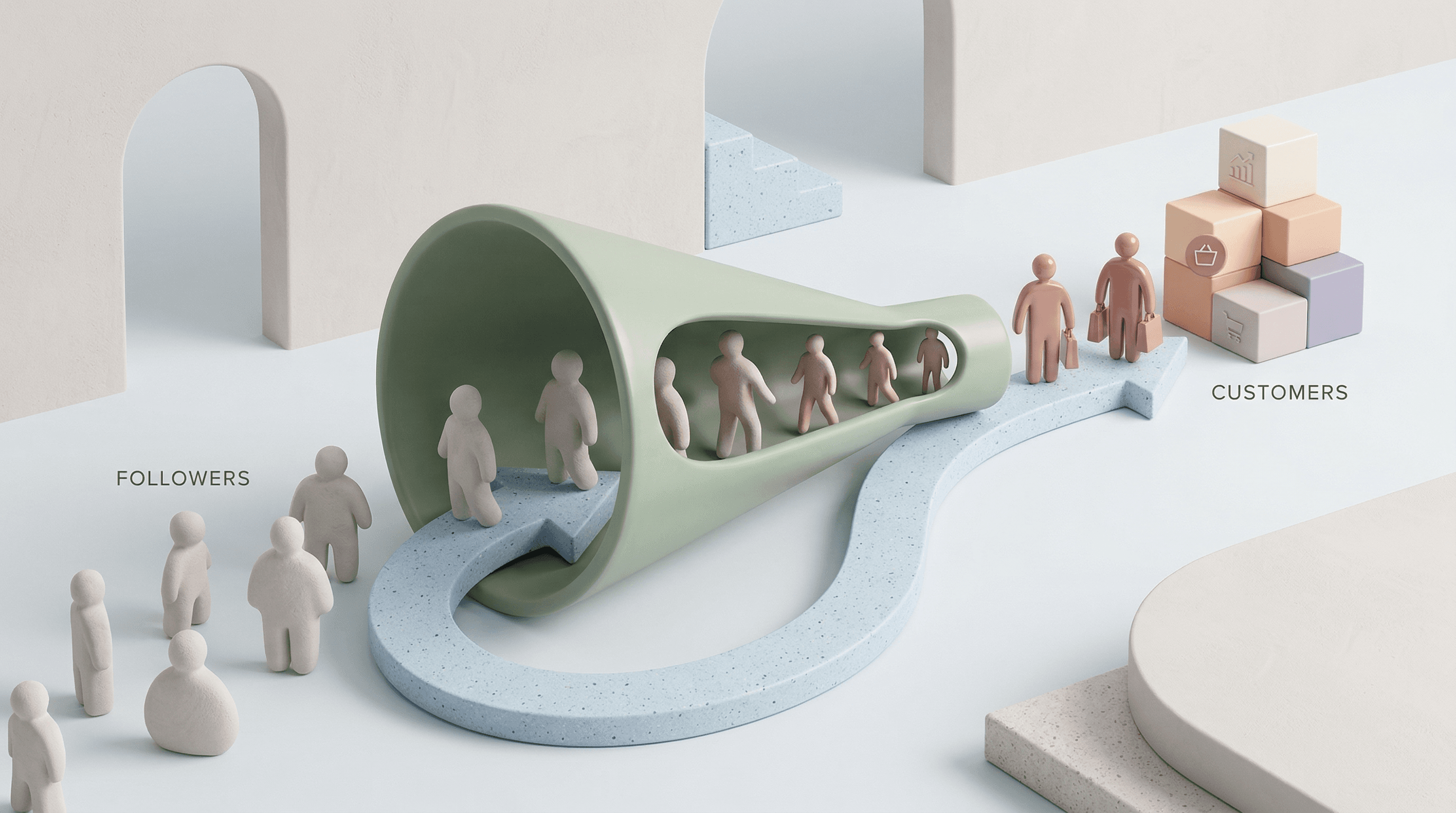
You have 200,000 followers. How many of them would actually buy something from you? The average creator converts 1% to 3% of their audience into paying customers, according to data from Kajabi and Gumroad's creator earnings reports. Creators with highly engaged, niche audiences often see 5% to 8%. That means even a modest conversion rate on a decent-sized audience can generate life-changing revenue. The question is not whether your audience will buy. It is whether you are offering them the right thing in the right way.
Trust as the Conversion Engine
Followers do not buy because you have a big number next to your name. They buy because they trust you. That trust is the most important asset in your business, and it is built through consistency, authenticity, and delivering value before asking for anything in return.
The creator-audience relationship has a unique psychological dynamic. Researchers call it the parasocial relationship: your audience feels like they know you personally, even though the interaction is largely one-directional. They have watched you share your experiences, your opinions, your expertise. They have seen you show up consistently over months or years. That familiarity creates a level of trust that no traditional marketing can replicate.
This trust transfers directly to products. A Morning Consult survey found that 50% of Millennials trust product recommendations from influencers they follow, compared to 38% who trust recommendations from traditional celebrities. For Gen Z, that number is even higher. When you recommend something, or better yet, when you build something, your audience starts from a position of trust rather than skepticism.
The critical point is that trust takes time to build and seconds to destroy. If you launch a product that does not deliver real value, or if your audience feels like you are just trying to extract money from them, that trust erodes fast. The best creator products strengthen the relationship rather than strain it.
Matching Product to Audience
The number one reason creator products fail is misalignment. The creator builds something they are excited about, but it does not match what the audience actually needs or wants. A tech creator launching a cookbook. A fitness creator launching a coding course. It sounds absurd stated plainly, but subtler versions of this mismatch happen all the time.
The good news is that your audience is already telling you what to build. You just need to listen systematically. Here are the places to look.
Comments and DMs are the richest source of product insight. Pay attention to questions that come up repeatedly. If fifty different people have asked you the same question in the last three months, that question is pointing at a product opportunity.
Polls and Q&A sessions let you ask directly. "What is the biggest challenge you face with [your niche topic]?" The answers will surprise you. People are remarkably honest when asked a straightforward question.
Content engagement patterns reveal priorities. Which of your posts, videos, or stories get the most saves and shares? Saves in particular indicate utility: people save content they plan to reference again. High-save content points toward problems your audience is actively trying to solve.
The product should solve a real problem or deliver real, ongoing value. Not just have your name on it. Your audience will pay for something that saves them time, makes them money, teaches them a skill, or gives them access to a community they cannot find elsewhere.
The Launch Playbook
A successful product launch is not a single event. It is a four-phase process that builds momentum over weeks.
Phase 1: Seed (4 to 6 weeks before launch). Start mentioning the problem your product solves in your regular content. Do not announce the product yet. Talk about the pain point. Share your own experience with it. Let your audience start thinking about the problem so that when you present the solution, it feels like a natural next step rather than a sudden sales pitch.
Phase 2: Tease (2 weeks before launch). Share behind-the-scenes glimpses of what you are building. Let your audience feel like insiders who are watching something come together. Open a waitlist and collect email addresses. This serves double duty: it gauges demand and gives you a direct channel to your most interested potential customers. A waitlist of 500 people is a strong signal. A waitlist of 5,000 means you are sitting on something real.
Phase 3: Launch (launch week). Create dedicated content across all your platforms. Be clear about what the product does, who it is for, and why it exists. Offer a founding member price or early adopter discount to reward the people who trusted you enough to be first. Urgency matters here, but it should be genuine. Limited-time founding pricing works because it is real: the price will actually increase after the launch period.
Phase 4: Sustain (ongoing). This is where most creators fail. They launch with a bang and then stop talking about the product. Keep it visible. Mention it naturally in your content. Share customer testimonials and success stories. Announce feature updates. A product that disappears from your content will disappear from your audience's attention.
Pricing Strategy for Creator Products
Pricing is where creators most often leave money on the table, usually by charging too little.
Do not undercharge. Your audience values quality, and pricing signals quality. A $5 per month tool feels disposable. A $19 per month tool feels like a real investment that the customer takes seriously. Paradoxically, higher-priced products often see better retention because customers who pay more are more committed to using the product and getting value from it.
Do not overcharge. Price should reflect the value delivered, not your follower count. A tool that saves a freelancer 5 hours per week is worth $49 per month easily. A tool that provides mild convenience might max out at $9.
The sweet spots for creator-led SaaS products break down roughly like this: $9 to $29 per month for consumer-facing tools and $29 to $99 per month for professional tools that serve people in their work. For a more detailed breakdown of how SaaS pricing works, check out our article on the SaaS business model explained for creators.
Annual pricing is a powerful retention mechanism. Offer a 15% to 20% discount for annual plans. Customers who commit for a year have dramatically lower churn rates, and you get the revenue upfront, which improves your cash flow. Founding member pricing (a permanent discount for early adopters) creates loyalty and rewards the people who believed in your product from day one.
Conversion Math That Changes Perspective
Let us run real numbers across different audience sizes to show why even modest conversion rates create meaningful businesses.
Scenario 1: 50,000 followers at 2% conversion at $19 per month. That is 1,000 customers generating $19,000 in monthly recurring revenue. That is $228,000 per year.
Scenario 2: 100,000 followers at 3% conversion at $29 per month. That is 3,000 customers generating $87,000 in monthly recurring revenue. That is over $1 million per year.
Scenario 3: 500,000 followers at 1% conversion at $15 per month. That is 5,000 customers generating $75,000 in monthly recurring revenue. That is $900,000 per year, from converting just one out of every hundred followers.
These numbers assume a one-time conversion event. Real growth comes from converting new followers into customers every month while retaining existing subscribers. With a 5% monthly growth rate in new conversions and 95% monthly retention, that $19,000 MRR in Scenario 1 grows to over $30,000 within a year.
These are the types of outcomes that BuildVentureLab works toward with creator partners: real recurring revenue businesses built on the trust and distribution that creators already have. The model is straightforward. The creator provides the audience and domain expertise. An experienced product team builds and scales the software. Both parties share in the upside.
For a deeper look at why your audience represents such a powerful business asset, read our article on why your audience is your most valuable startup asset. And for a comparison of how subscription revenue stacks up against ad-based income, our breakdown of recurring revenue versus ad revenue puts the numbers side by side.
Your followers are not just a number on a screen. They represent potential customers, community members, and advocates for something you have not built yet. Converting them requires the right product, a thoughtful launch strategy, and pricing that reflects real value. Start with trust. Build from there. The math, once you see it, tends to take care of itself.
Built by the team behind a $1B+ SaaS portfolio
Over the past decade, our 90+ person team has launched and scaled SaaS products across every vertical, generating over $1B in company-wide revenue. Now we partner with creators and manage every aspect of the product, from build through ongoing growth. You bring the distribution. We bring everything else.
Apply for a Partnership