Subscription Pricing Strategies for Creator Products
June 2024 · 8 min read
Creators consistently make the same pricing mistake. They look at what others charge, pick a number slightly lower, and hope for the best. This approach ignores the most important variable in pricing: how your audience perceives value. A product priced at $9 per month signals "nice to have." A product priced at $39 per month signals "essential tool." The number you choose communicates more than cost. It communicates positioning. Getting your creator subscription pricing strategy right is one of the highest leverage decisions you will make as a product owner.
The Psychology of Creator Subscription Pricing
Creator products carry a unique advantage: the trust premium. Audiences who follow a creator for months or years develop a relationship that makes them more willing to pay than a cold prospect encountering a generic software tool. Research shows that consumers are willing to pay 10% to 30% more for products recommended by creators they trust compared to products discovered through advertising.
This trust premium is real and measurable. Creators who price as if they are competing with commodity software leave significant revenue on the table. The willingness to pay is not just about the product features. It is about the relationship between the creator and the buyer. When someone has followed your content for two years and genuinely values your expertise, they are not comparing your product to every alternative on the market. They are buying from you specifically.
Price anchoring plays a significant role here. A 2024 SaaS benchmarking report found that 67% of pricing page abandonment happens when customers suspect hidden costs. Transparency builds on the trust your audience already has. Display your prices clearly, explain what each tier includes, and never surprise your users with unexpected charges.
Common Pricing Models for Creator Products
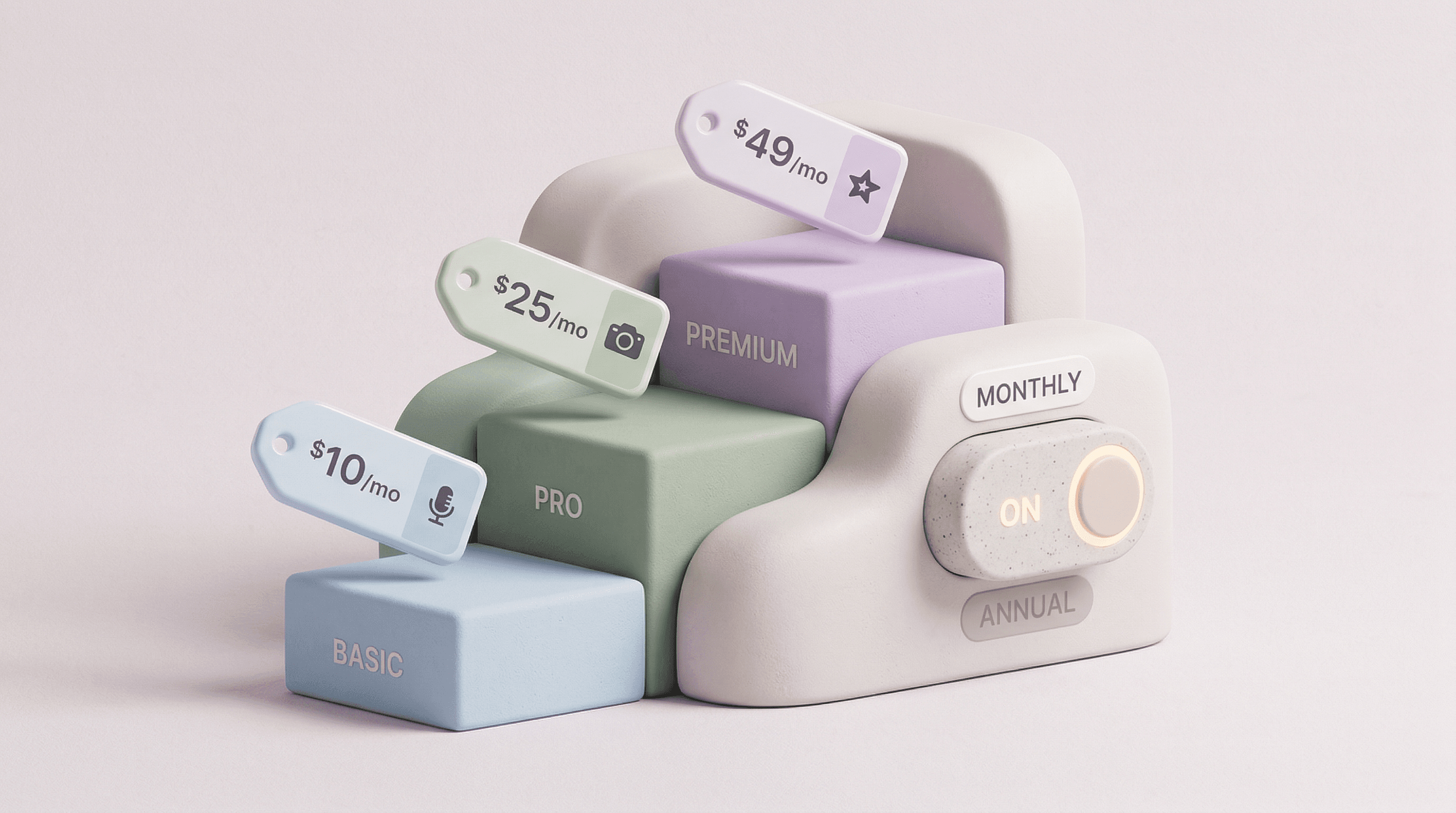
Flat monthly subscription ($9 to $49 per month). Simple, easy to communicate, works well for single feature tools and focused utility products. This model is ideal when your product does one thing exceptionally well and your audience does not need complexity. The simplicity reduces decision friction and makes the value proposition immediately clear.
Tiered pricing (three tiers). Typically structured as Basic, Pro, and Premium. Allows different audience segments to self select based on their needs and budget. The middle tier usually captures the majority of subscribers. A 2024 conversion analysis found that pricing pages with four or more tiers convert 31% worse than three tier pages. Keep it simple. Three options is the sweet spot.
Freemium. A free tier with limited features and a paid tier with full access. Effective for growing a user base quickly, but requires a clear and compelling upgrade path. The average freemium to paid conversion rate across SaaS companies is 2% to 5%, according to OpenView Partners. Top performers reach 5% to 10%. Freemium only works if the free tier delivers enough value to hook users while leaving enough locked behind the paywall to justify upgrading.
Annual discount. Offering 15% to 20% off for annual prepayment reduces churn, improves cash flow, and locks in revenue. The most popular discount structure is 16.7%, which maps to a "two months free" offer on an annual plan. SaaS buyers are nearly split between monthly and annual subscriptions, with approximately 42% choosing monthly and 45% choosing annual, according to recent procurement data. Offering both options is best practice.
Finding Your Creator Subscription Pricing Strategy
Value based pricing starts with the question: how much is the problem you solve worth to your audience? If your fitness app saves someone $100 per month in gym membership costs, pricing at $19 per month is an easy decision for the buyer. The customer perceives a five to one return on investment, making the purchase feel like a bargain rather than an expense.
Cost based pricing starts with your expenses and adds a margin. This approach is simpler but often results in underpricing because it ignores the perceived value to the customer. If your server costs are $2 per user per month and you price at $9, the margin looks healthy. But if users would happily pay $29 for the value you deliver, you are leaving $20 per user per month on the table.
The best approach combines both: understand your costs, understand your value, and price in the range where the customer feels they are getting a clear deal. For a deeper look at how to convert your audience into paying customers, read our guide on the conversion playbook for turning followers into customers.
Market Data on Creator Product Pricing
Creator communities and membership products tend to cluster between $26 and $50 per month, with premium communities charging $100 or more. The value proposition for communities is access: access to the creator, to a peer group, and to exclusive content or resources.
B2B SaaS products built by creators in professional niches (marketing tools, analytics dashboards, workflow automation) typically price higher, starting at $49 per month and scaling to $199 per month for team plans. The business context justifies higher pricing because the buyer is making a professional investment, not a personal one.
Consumer SaaS products (fitness trackers, meal planners, creative tools) tend to price between $9 and $29 per month. The pricing should reflect the audience's professional context. A product for hobbyists prices differently than a product for business owners. Understanding who your buyer is and what context they are buying in determines where your price should land.
Pricing Mistakes to Avoid
Racing to the bottom. Competing on price against larger, better funded products is a losing strategy. You cannot outspend Notion or Canva on infrastructure and marketing. But you can outcompete them on relevance and trust. Your audience chose you for a reason. Price accordingly.
Too many tiers. More than three pricing tiers creates decision paralysis. Every additional option forces the buyer to compare, evaluate, and second guess. The result is not more upgrades. It is more abandoned pricing pages. Keep it simple.
Frequent price changes. Changing prices every few months erodes trust and creates anxiety among existing subscribers. If you need to adjust pricing, do it deliberately, communicate the reasons clearly, and grandfather existing users whenever possible.
Hiding the price. Making users request a demo or "contact sales" for a consumer product creates unnecessary friction. A 2024 study found that 67% of potential customers abandon a pricing page when they suspect hidden costs. Be transparent. Your audience expects honesty from you. Do not break that expectation on the pricing page. For more on the common mistakes that derail creator product launches, read our analysis of why creators fail at product launches.
Price is a signal. It tells your audience whether your product is a toy or a tool. It communicates how seriously you take the problem you are solving. The right creator subscription pricing strategy is not the one that maximizes immediate signups. It is the one that attracts the right customers, sustains the business, and reflects the genuine value your product delivers. At BuildVentureLab, pricing strategy is one of the first things we work through with creators building new products. Get it right, and pricing becomes one of your biggest competitive advantages.
Built by the team behind a $1B+ SaaS portfolio
Over the past decade, our 90+ person team has launched and scaled SaaS products across every vertical, generating over $1B in company-wide revenue. Now we partner with creators and manage every aspect of the product, from build through ongoing growth. You bring the distribution. We bring everything else.
Apply for a Partnership