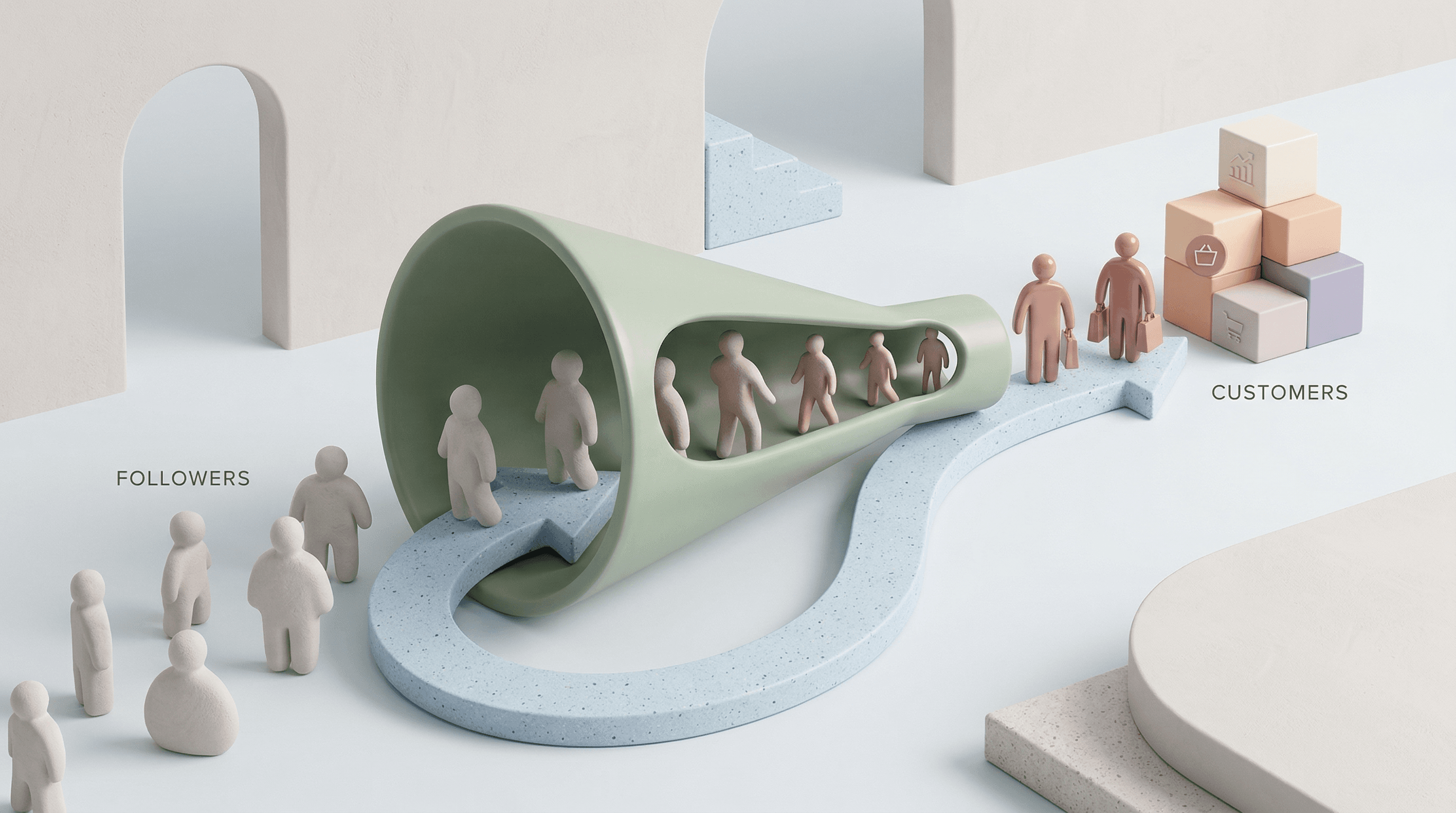
Instagram Monetization Beyond Brand Deals: Building Lasting Revenue
October 2025 · 8 min read

In 2021, 91% of Instagram creators relied on brand partnerships as their primary revenue source. By 2024, that number had dropped to 68.8%, according to Influencer Marketing Hub's annual benchmark report. The shift is not because creators stopped wanting sponsorships. It is because a growing number of them realized that building a business on someone else's willingness to pay you is not really building a business at all.
The creators who left that 91% did not stop working with brands entirely. They just stopped depending on them. And what they built instead is worth paying attention to.
The Brand Deal Ceiling
Brand deals are straightforward: a company pays you to feature their product in your content. The rates look attractive on paper. According to Later and Mavrck's 2024 creator rate data, Instagram creators with 10,000 to 50,000 followers charge an average of $100 to $500 per post. Creators between 50,000 and 500,000 followers charge $500 to $5,000. And those above 500,000 can command $5,000 to $25,000 or more per integration.
Those numbers sound reasonable until you look at how they scale. More money from brand deals means more pitching, more contracts, more revision rounds, more content calendars you do not control. Every deal requires effort to land and effort to fulfill. There is no compounding here. Two deals this month does not make next month easier. It just means you need to find two more.
Seasonal volatility makes things worse. Brand budgets typically contract in Q1 after holiday spending and again in Q3 before the fall push. Creators who rely heavily on sponsorships know the feeling of January and July inboxes going quiet. Your income can swing 40% or more between quarters for reasons that have nothing to do with your content quality.
Then there is the rate plateau. Unless you are in the top fraction of a percent of creators, brand deal rates flatten once you hit a certain audience size. Doubling your followers from 250,000 to 500,000 does not double your rates. Brands are buying reach, and reach has diminishing returns in their models. You end up working harder for roughly the same money.
Instagram's Limited Direct Monetization
If brand deals are the main path, what does Instagram itself offer? The honest answer: not much.
Instagram Subscriptions launched in 2023, allowing creators to charge $0.99 to $99.99 per month for exclusive content. The feature exists, but adoption has been modest. Unlike YouTube Memberships, which benefit from the platform's strong recommendation algorithm for member content, Instagram Subscriptions compete with a feed that already buries organic reach. Most creators report subscriber counts in the low hundreds, generating a few hundred dollars per month at best.
Instagram Badges, available during Live sessions, let viewers tip creators in small increments. The earnings are minimal for most creators. You might pull in $20 to $100 during an active Live session, but Live viewership has declined as Reels and Stories dominate the platform's priorities.
Instagram's Bonuses programs have been the most unpredictable of all. Meta has repeatedly launched, paused, and restructured bonus programs for Reels creators. In 2023, Meta scaled back its $1 billion creator investment that it had announced in 2022, leaving many creators who had optimized their content for bonuses suddenly without that income stream.
Compare this to YouTube, where the Partner Program pays creators a consistent 55% of ad revenue on their videos. YouTube creators with similar audience sizes to Instagram creators often earn multiples more from the platform itself. Instagram was designed to generate advertising revenue for Meta, not to share that revenue with the people creating the content that keeps users scrolling.
What Successful Instagram Creators Are Doing Instead
The creators who have moved beyond brand deal dependency share a common strategy: they treat Instagram as a distribution channel rather than a revenue source.
Digital products have become the first step for many. Guides, templates, presets, and mini-courses sold through link-in-bio tools generate direct revenue without platform middlemen. A photography creator selling a $39 Lightroom preset pack to 200 buyers per month earns $7,800 with no brand approval needed. A fitness creator selling a $29 workout guide can reach similar numbers. These are not life-changing sums on their own, but they represent income the creator controls entirely.
Email lists are the second piece. Smart Instagram creators funnel followers to an email list, removing their dependence on the algorithm. Instagram's organic reach has declined steadily. Creators now reach an estimated 9.4% of their followers with a typical feed post, down from over 16% in 2020. An email list bypasses this entirely. When you own the contact, you own the relationship, regardless of what Instagram does with its algorithm.
Community models are the third evolution. Creators using platforms like Circle, Skool, or paid Discord servers charge members $20 to $100 per month for ongoing access. A creator with 300 community members at $40 per month generates $12,000 in monthly recurring revenue. That is stable, predictable, and entirely independent of any brand partnership cycle.
The Product Alternative
Digital products and communities are meaningful steps, but the highest-leverage move for Instagram creators is building a product that generates recurring revenue at scale. For a detailed comparison of how recurring revenue compares to advertising income, our article on recurring revenue versus ad revenue for creators breaks down the math.
The traditional product path for Instagram creators has been physical goods: clothing lines, skincare, food products. These work for creators with massive audiences, but they come with thin margins (often 20% to 40%), inventory risk, and supply chain complexity. Software products flip that equation. A SaaS tool operates at 80%+ gross margins, requires no physical inventory, and generates monthly recurring revenue from each customer.
Instagram audiences are particularly well suited for product launches because the platform is built around visual discovery and lifestyle aspiration. Purchase intent on Instagram is high: 44% of Instagram users report shopping on the platform weekly, according to Meta's 2024 internal data. When a creator recommends a product they actually built, rather than one they were paid to promote, the conversion rates tend to be meaningfully higher.
The path from Instagram creator to software business owner does not require you to learn to code. Companies like BuildVentureLab partner with creators to handle the product design, engineering, and scaling. The creator brings what no amount of venture capital can buy: a trusted audience that already listens. The creator holds equity in a real business rather than cashing one-time sponsorship checks.
Building on Owned Ground
The fundamental problem with depending on any single platform is that you do not control it. Instagram can change its algorithm, deprioritize your content format, or restructure its monetization programs at any time. And it does, regularly.
A product with its own customer base gives you stability that no platform can take away. Your customers pay you directly. You communicate with them through email. You iterate on the product based on their feedback. Instagram becomes one of several channels you use to grow, not the foundation your entire income depends on.
This is the shift from renting your income to owning it. Brand deals are rented income: they exist only as long as brands keep choosing to work with you. A product you own generates revenue as long as customers find it valuable. For a practical guide on making this transition, see our article on converting followers into paying customers.
The smartest Instagram creators also understand that their audience itself is an asset. As we explored in our piece on why your audience is your most valuable startup asset, the distribution advantage a creator holds is worth more than most people realize. A traditional startup would spend hundreds of thousands of dollars to build the kind of engaged, trusting audience you already have.
Brand deals are not going away, and they can still be a valuable part of your revenue mix. But the creators who will build lasting wealth are the ones who use their Instagram presence to create something they own. The question is not "how do I get more brand deals?" It is "what would my audience pay for every month?" Once you start asking that question, the answer usually becomes obvious faster than you expect.
Built by the team behind a $1B+ SaaS portfolio
Over the past decade, our 90+ person team has launched and scaled SaaS products across every vertical, generating over $1B in company-wide revenue. Now we partner with creators and manage every aspect of the product, from build through ongoing growth. You bring the distribution. We bring everything else.
Apply for a Partnership