
The Creator Economy by the Numbers: A 2024 Market Breakdown
July 2024 · 10 min read
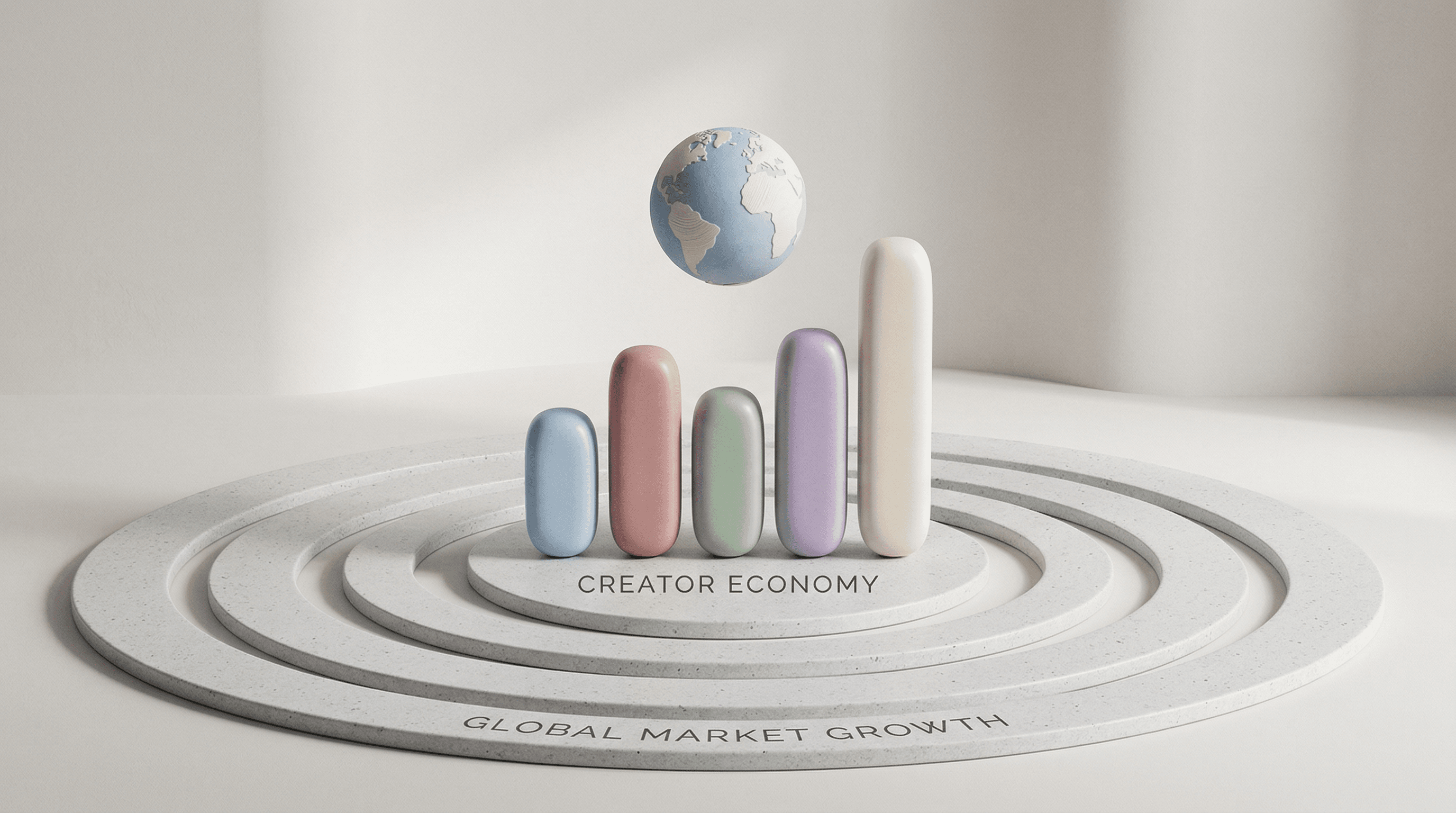
The creator economy hit $205 billion in 2024. Goldman Sachs projects it will reach $480 billion by 2027. These are not aspirational projections from startup pitch decks. They are institutional estimates backed by observable revenue data across every major platform. Understanding where the money flows, who earns it, and where the gaps exist is essential for any creator thinking about building a business. The numbers tell a story of massive opportunity, but also of massive inequality. Here is a data driven look at the creator economy market size in 2024 and what it means for the next decade.
Creator Economy Market Size and Growth
The creator economy's total addressable market exceeded $205.25 billion in 2024, according to Grand View Research. That figure makes it larger than the global music industry and comparable to the global gaming market. SNS Insider places the number at $203.6 billion, while Goldman Sachs Research estimates the broader market at $250 billion when factoring in adjacent services and platforms.
The compound annual growth rate sits between 22% and 23%, which means the market is roughly doubling every three to four years. Multiple financial institutions project the market will surpass $1 trillion by the early 2030s. Grand View Research forecasts $1.35 trillion by 2033. SNS Insider projects $1.18 trillion by 2032.
This growth is not coming from more people watching videos. It is coming from new revenue models, deeper audience relationships, and the emergence of creator owned products and services. The shift from ad revenue dependency to diversified income streams is the engine behind the acceleration. Creators who understand this shift are positioning themselves to capture disproportionate value.
Geographic Distribution of the Creator Economy
North America accounts for 34% to 37% of total creator economy revenue, with the United States alone representing approximately $50.9 billion to $56.3 billion depending on the research source. The U.S. market is projected to reach over $300 billion by the mid 2030s, driven by mature platform infrastructure and high advertiser spending.
Asia Pacific is the fastest growing region, driven by massive platform adoption in India, Southeast Asia, and parts of East Asia. India alone contributes a significant share of YouTube creators, with 17 of the top global channels originating from the country.
Europe trails behind North America but is accelerating, particularly in the United Kingdom, Germany, and the Nordics. The geographic spread matters because it reveals where infrastructure is mature and where the opportunity is still early stage. Creators building products for global audiences should pay attention to where their users actually are, not just where the loudest conversations happen.
Platform Breakdown: Where Creators Operate
YouTube hosts an estimated 61.8 million active creators as of 2024, making it the single largest creator platform by volume of active producers. The platform generated $36.1 billion in ad revenue in 2024, up from $31.5 billion in 2023. YouTube remains the dominant platform for long form content and the most reliable source of ad revenue sharing.
Instagram has approximately 65 million influencer accounts globally, though the definition of "influencer" varies widely across data sources. The platform remains the top choice for brand partnerships, with 80.8% of U.S. marketers using Instagram for influencer marketing campaigns.
TikTok is the preferred platform for 45% of creators under 30, driven by its algorithmic discovery engine and lower barrier to viral reach. The platform surpassed 1.8 billion monthly active users in 2024 and its creators collectively earned $4.1 billion that year. Nano influencers on TikTok hold the highest engagement rate at 10.3%, making it the most effective platform for organic discovery.
LinkedIn reached one billion registered users in 2024 and is the most undermonetized major platform for creators. There is no creator fund, no tipping, and minimal direct monetization support. Yet its audience has the highest average purchasing power. With 175 million premium subscribers and 70 million business accounts, LinkedIn represents an enormous untapped opportunity for creators building B2B products and professional services. For a deeper look at this opportunity, read our analysis of the LinkedIn B2B creator opportunity.
Each platform represents a distinct audience, distinct content format, and distinct monetization landscape. Creators who build products need to understand which platform dynamics align with their product strategy.
Income Distribution: The Creator Economy Market Size Gap
More than 50% of creators earn under $15,000 per year. This is the most quoted and most important statistic in the creator economy. Only 4% of creators earn over $100,000 annually. The income distribution resembles a power law curve, not a bell curve.
The gap between the top earners and the rest is widening. According to recent data, the top 10% of creators received 62% of ad payments in 2025, up from 53% in 2023. Median creator earnings actually declined from $3,500 to $3,000 during the same period. The rich are getting richer, and the middle is getting squeezed.
Creators with diversified revenue streams (three or more) earn approximately $75,000 more per year than those with a single income source. Nearly 45% of full time creators who own a brand earn close to $100,000 annually. The pattern is clear: income inequality in the creator economy is not a content quality problem. It is a business model problem. Most creators are excellent content producers but have no business infrastructure to capture the value they create. To understand why this gap exists and how to close it, read our breakdown of the audience monetization gap in the creator economy.
Investment Activity in the Creator Economy
Creator economy startups raised over $900 million in 2024, with the second quarter alone seeing nearly $700 million in funding. That represents a 68% increase from the previous year. Since early 2021, startups in the creator economy have secured nearly $15 billion in total venture capital.
AI focused creator startups led the investment wave. Companies like Captions and ElevenLabs raised significant Series C rounds backed by Andreessen Horowitz. Tools for content generation, automated dubbing, editing, and audience analytics attracted the lion's share of capital. Social commerce platforms also saw major rounds, with Flip raising $144 million in a Series C.
Beyond venture capital, established media companies and creator networks began launching their own investment vehicles. Night Ventures, the early stage fund of Night Media (which manages top creators like MrBeast), strategically focuses on creator economy startups. Slow Ventures launched a $60 million dedicated creator fund. The investment thesis is clear: creators represent the most efficient distribution channel in consumer and B2B markets, and the infrastructure supporting them is still being built.
The creator economy market size in 2024 is massive and growing rapidly. But the opportunity is not evenly distributed. The creators who will capture disproportionate value in the next decade are not the ones posting the most content. They are the ones building beyond content. Products, software, and owned revenue streams are what separate the top 4% from the other 96%. Companies like BuildVentureLab exist to bridge that gap, giving creators the product development infrastructure they need to participate in the highest growth segments of this market.
Built by the team behind a $1B+ SaaS portfolio
Over the past decade, our 90+ person team has launched and scaled SaaS products across every vertical, generating over $1B in company-wide revenue. Now we partner with creators and manage every aspect of the product, from build through ongoing growth. You bring the distribution. We bring everything else.
Apply for a Partnership